

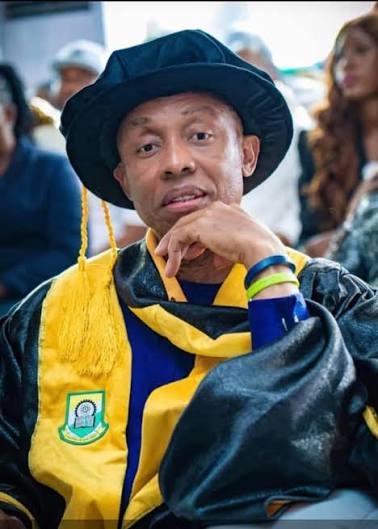
A former Chairman of the National Human Rights Commission (NHRC), Prof Chidi Odinkalu, has raised fresh questions over President Bola Tinubu’s nationality, educational history and family background.
He stated that the key aspects of the Nigerian leader’s personal records remain unclear.
Odinkalu, a Professor of law, made the remarks during an interview posted on social media, where he criticised what he described as inconsistencies in the President’s publicly available records.
According to him, Nigerians still do not know the President’s true nationality because of controversies surrounding a Guinea diplomatic passport allegedly linked to Tinubu.
“We have a president whose nationality we do not know because he carries a Guinea diplomatic passport,” Odinkalu said.
He continued: “Whose parentage, whose genealogy we do not know and we now understand that President Buhari thought the same thing too; whose primary school we do not know, whose secondary school we do not know, and who now claims to have gone to university.”
The senior lawyer questioned how someone could claim to have earned a university degree without verifiable records of primary and secondary education.
According to him, if the President was homeschooled, as he said had once been suggested by Minister of Aviation and Aerospace Development, Festus Keyamo (SAN), that information ought to have been clearly disclosed in official documents.
“If he was home-schooled, as Festus Keyamo posited, famously then they should say so,” Odinkalu stated.
“It should be written in the form. Home-schooled should be disclosed, and home-schooled does not mean you don’t have a certificate. Home-schooled is a preparatory process. After that, you go forward for certification.”
He further alleged that previous information supplied about Tinubu’s educational history had been changed over time.
“But the thing is that he had claimed Government College Ibadan, by the way, in previous forms, and he had claimed other things that proved false,” he said.
“And now they are trying to make up records or to clean up records in order to align with a current eligibility threshold.”
Odinkalu argued that it would ordinarily be a source of pride for any school to identify a former student who eventually became President of Nigeria.
“How do you not go through primary and secondary certification but you have a university degree?” he asked. “Is it not an achievement for a school to have produced a president, no matter how remote the school could have been?”
Drawing from his own experience, the former NHRC chairman said he could still identify the primary school he attended despite beginning his education under difficult circumstances following the Nigerian Civil War.
“I started off primary school as an internally displaced person after the Nigerian Civil War. And I know the primary school I started off in. If I mention it to you, it’s not in any place on the map. But I take pride in it. I take pride in the fact that I passed through that primary school. I cannot understand,” he explained.
Tinubu’s educational qualifications and personal records have remained the subject of political and legal disputes for several years.
During the 2023 presidential election litigation, opposition parties challenged aspects of the President’s academic credentials and documents submitted to the Independent National Electoral Commission (INEC). However, the Supreme Court ultimately upheld Tinubu’s election, while the President has consistently maintained that he lawfully contested the election and met all constitutional requirements for office.
The Presidency has also repeatedly defended Tinubu’s academic credentials and personal records, dismissing allegations questioning his eligibility as politically motivated.
