

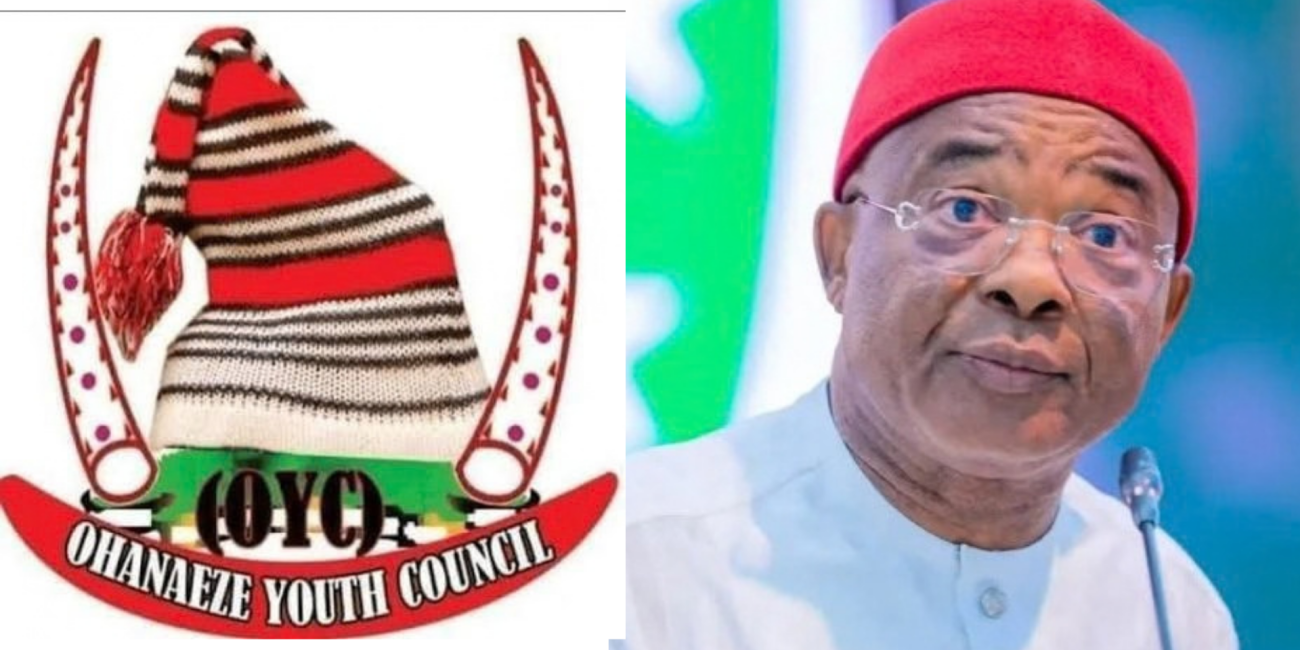
The Ohanaeze Youth Council (OYC) has given Imo State Governor Hope Uzodimma 48 hours to apologise to Ndigbo over his reference to “Igbo minorities” and “Igbo majorities” in the context of political representation in the administration of President Bola Ahmed Tinubu.
The youth organisation described the governor’s comments as divisive and potentially harmful to Igbo unity, demanding that he retract the statement and clarify his position.
The demand was contained in a statement issued on October 5, 2026, by the National President of the OYC, Comrade Igboayaka O Igboayaka.
Uzodimma had, in his Independence Day address on October 1, reportedly questioned why what he described as “Igbo minorities” were being presented as the majority representatives of the Igbo people in the Tinubu administration.
The governor was also quoted as arguing that a section of the Igbo population was being presented as speaking for or representing the broader Igbo community in the Federal Government.
Reacting to the comments, Igboayaka rejected the distinction between “Igbo minorities” and “Igbo majorities”, insisting that the Igbo people should be regarded as one people irrespective of their state of residence or geographical location.
“There are no Igbo minorities or Igbo majorities existing in any part of the world. The Igbo race is one. There is no lesser, greater or superior Igbo anywhere,” he said.
The OYC leader accused the governor of introducing ethnic sentiments into political disagreements and urged him to separate his political interests from issues concerning the collective identity and unity of Ndigbo.
Igboayaka said Uzodimma should “desist whipping ethnic sentiments when waging his personal political war, which has no benefit with Igbo collective interest.”
He also criticised some Igbo politicians whom he accused of making divisive statements in pursuit of personal political ambitions.
According to him, political leaders from the Southeast should focus more on issues capable of advancing the region’s economic development and infrastructure rather than making statements that could deepen divisions among the people.
Igboayaka challenged Uzodimma to devote greater attention to attracting major infrastructure and economic projects to the Southeast.
He specifically called for efforts to promote the development of proposed deep-sea port opportunities in the region, including the dredging and development of Ose-Akwa Ihiala and Ose-Motto Ugota.
He argued that such projects could contribute significantly to trade, industrialisation, employment and economic development in the Southeast.
The OYC leader also cited the Gateway Deep Sea Port project in Ogun State as an example of the type of infrastructure initiative he believes Southeast governors should pursue.
He urged Uzodimma to emulate what he described as the efforts of Ogun State Governor Dapo Abiodun in attracting major investment and infrastructure to the state.
According to Igboayaka, the Gateway Deep Sea Port project, being developed in partnership with DP World, is expected to strengthen Ogun State’s position as a major maritime and commercial hub.
The OYC president demanded that Uzodimma withdraw his reference to “Igbo minorities” and “Igbo majority” within 48 hours.
He warned that failure to respond could attract strong reactions from traditional and cultural stakeholders, while also invoking spiritual consequences.
Igboayaka argued that there was no basis for categorising members of the Igbo ethnic group as superior or inferior based on their state of residence.
He cited the Jewish people as an example, arguing that the existence of different tribes among the Israelites did not necessarily translate into distinctions between “minority” and “majority” Jews.
The OYC leader maintained that the same principle should apply to the Igbo people, irrespective of where individual members live.
He argued that an Igbo person residing outside the Southeast should not be considered less Igbo than someone living in one of the five Southeast states.
“If Yorubas or Hausas have minorities and majority of the same tribe among them, there is no such thing existing among the Igbos,” he said.
He added that an Igbo person indigenous to states such as Benue, Bayelsa, Rivers, Kogi, Delta, Edo, Akwa Ibom or Cross River should not be regarded as inferior to an Igbo person from Imo, Anambra, Ebonyi, Abia or Enugu.
Igboayaka further expressed concern about what he described as declining quality of leadership among some Igbo political figures.
He argued that political leaders should avoid statements that could undermine the collective dignity and unity of the Igbo people.
The OYC leader accused Uzodimma of making what he described as an anti-Igbo and divisive remark, insisting that the governor should be more conscious of the potential consequences of his public statements.
He said political disagreements should not be allowed to create divisions within the wider Igbo community.
The latest controversy adds to the ongoing political debates over the role of Southeast politicians in the Tinubu administration and the extent to which individual political interests align with broader regional expectations.
While political leaders across the Southeast have adopted different positions on the Federal Government and the 2027 political landscape, the OYC said such differences should not translate into the categorisation of Igbo people into superior and inferior groups.
The council maintained that the Igbo identity transcends state boundaries and political affiliations.
It therefore urged Governor Uzodimma to reconsider his remarks, retract the controversial terminology and apologise to Ndigbo in the interest of unity.
The OYC said it remained committed to promoting what it described as the collective interests, dignity and unity of the Igbo people while encouraging political leaders to focus on development, economic opportunities and issues that directly affect the people.
