

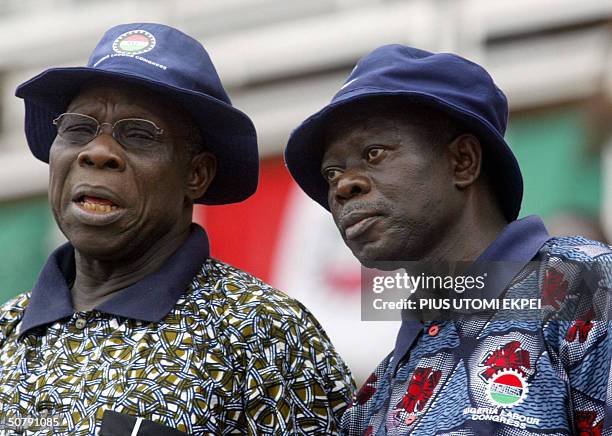
During the interview, the journalist asked Oshiomhole why he mobilised Nigerian workers and other citizens to protest petrol price increases of between ₦3 and ₦7 per litre under former President Olusegun Obasanjo, while appearing to defend a situation in which petrol prices have reportedly risen to between ₦1,400 and ₦1,500 per litre under the Tinubu administration.
The question brought attention to Oshiomhole’s longstanding record as a labour leader who organised nationwide demonstrations against increases in the prices of petroleum products. His leadership of the NLC placed him at the forefront of organised labour’s resistance to government policies considered detrimental to workers and ordinary Nigerians.
However, when the interviewer pressed him to account for the apparent difference between his previous position and his current stance, the exchange became heated.
Oshiomhole challenged the interviewer’s authority, asking, “Who are you?” He also referred to his history of confronting military dictators, suggesting that he had never been intimidated by powerful political leaders.
The interviewer continued to press him on the comparison, seeking an explanation for why fuel price increases that attracted strong opposition during his years in organised labour were now being treated differently under the current administration.
Rather than directly addressing the comparison in the manner the interviewer sought, Oshiomhole pushed back against the line of questioning. He questioned the journalist’s knowledge and resisted repeated attempts to focus the discussion on his previous campaigns against fuel price increases.
The confrontation has renewed debate about the consistency of Oshiomhole’s positions on fuel pricing, subsidy reforms and the economic challenges facing Nigerians.
As NLC president, Oshiomhole was one of the prominent figures associated with organised labour’s opposition to successive attempts by previous administrations to increase petrol prices. The union argued that higher fuel costs would increase transportation expenses, raise the prices of goods and services, and further reduce workers’ purchasing power.
His activism helped establish his public image as a labour leader prepared to confront government policies over their effects on ordinary citizens.
However, Oshiomhole has previously offered an explanation for his opposition to fuel subsidy reforms under Obasanjo. He argued that the government at the time lacked adequate structures and safeguards to ensure that savings from subsidy removal would translate into tangible benefits for Nigerians.
According to this position, the issue was not simply whether subsidies should be removed, but whether the government had credible mechanisms to protect citizens and ensure that the resulting savings were properly utilised.
He has maintained that circumstances have changed since then, providing a basis for his different position on the current administration’s economic policies.
The debate has become particularly significant as Nigerians continue to grapple with rising living costs, transportation expenses and pressure on household incomes following the removal of the petrol subsidy in May 2023.
The Tinubu administration has defended its economic reforms as necessary measures to address fiscal pressures and redirect public resources towards other priorities. Critics, however, have questioned the pace of implementation and the adequacy of measures intended to cushion the effects on low-income households.
Oshiomhole’s exchange with the interviewer has therefore placed his political evolution and his understanding of economic reforms under renewed scrutiny.
The central question remains whether the differences between his positions reflect changed economic circumstances and policy considerations or a departure from the principles that guided his earlier labour activism.
For many Nigerians, the debate goes beyond Oshiomhole himself. It raises broader questions about accountability, consistency in public leadership and the responsibility of political officeholders to explain how their present positions align with their past advocacy.
As the country continues to navigate the consequences of fuel price liberalisation, public figures who previously led protests against similar policies are likely to face continued demands to explain their positions and demonstrate how current reforms will improve the lives of ordinary citizens.
- June 2000: Oshiomhole and the NLC shut down fuel stations and launched mass protests after the Obasanjo government increased petrol prices (moving from lower amounts by incremental or overnight adjustments).
- February 2002: The NLC organized strikes after petrol moved from ₦22 to ₦26 per litre, alongside increases in diesel and kerosene.
- June 2003: Protests erupted following a hike that pushed petrol to ₦40 per litre as part of federal deregulation and subsidy reform policies.
- January 2004: Oshiomhole led a general strike against a new fuel tax introduced by the federal government, which was eventually suspended after court rulings and labor pushback.
