

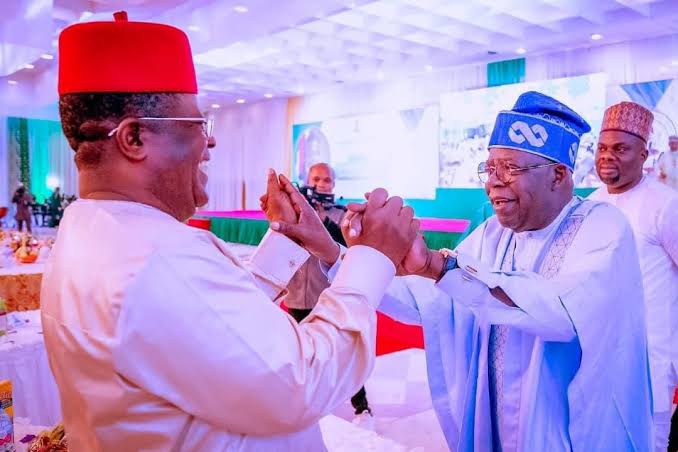
Minister of Works, David Umahi, has said President Bola Tinubu is committed to integrating the South-East into the Federal Government’s development agenda, urging people of the region to look beyond political sentiments and acknowledge ongoing infrastructure projects being executed by the administration.
Umahi made the remarks while speaking on federal road and infrastructure projects in the South-East. He argued that the scale of projects currently being undertaken demonstrates the President’s intention to address longstanding developmental concerns in the region.
The minister said he has often faced criticism for publicly supporting the Tinubu administration but insisted that he remains convinced that he has a duty to speak honestly about what he believes is happening in the South-East.
According to him, many people in the region have accused him of being overly supportive of the Federal Government whenever he asks them not to judge the administration solely through the lens of politics.
“For the first time, we are being remembered. Sometimes I tell our people not to be sentimental, and that is why they insult me, but I accept the criticism,” Umahi said.
He stated that he believes he was divinely positioned to speak to the people of the South-East at this period, insisting that his message is based on conviction rather than political expediency.
“Tomorrow they will discover that God sent me at a time like this to tell the truth, and that truth is that the President has good intentions for the people of the South-East,” he added.
Umahi maintained that the ongoing federal projects in the region are evidence of the administration’s commitment to inclusion and balanced national development. He said the projects should be seen as practical efforts to integrate the South-East more fully into the country’s economic and infrastructure framework.
The former governor of Ebonyi State also suggested that his presence in the Federal Executive Council has helped attract attention to the region’s developmental needs. He argued that his familiarity with the challenges facing the South-East enabled him to advocate effectively for federal projects.
“If I were not the minister from the South-East, we would not have been able to secure many of the projects we are getting today,” he said.
According to Umahi, President Tinubu gave him a clear mandate to address what he described as historical neglect of the South-East in federal infrastructure planning.
“It is the intention of Mr President to right the wrongs of the South-East,” the minister stated.
He did not provide a detailed list of projects during the remarks, but his comments come amid ongoing federal road construction and rehabilitation efforts across several South-East states.
Umahi urged residents of the region to assess the administration based on tangible projects rather than partisan considerations. He argued that infrastructure development has the potential to improve economic activities, transportation and social integration across the South-East.
The minister also appealed for greater cooperation between the region and the Federal Government, saying constructive engagement would yield more benefits than political hostility.
His comments are likely to generate debate within the South-East, where opinions remain divided over the Tinubu administration. Supporters of the government have pointed to ongoing infrastructure projects as evidence of increased federal attention, while critics argue that broader political and economic concerns affecting the region remain unresolved.
Umahi, however, insisted that the current administration should be given credit for what he described as deliberate efforts to include the South-East in national development priorities. He said history would ultimately judge the government by its actions and the projects delivered to the people.
The minister concluded by urging South-East residents to remain hopeful and to continue supporting initiatives that promote development, unity and national integration.
