

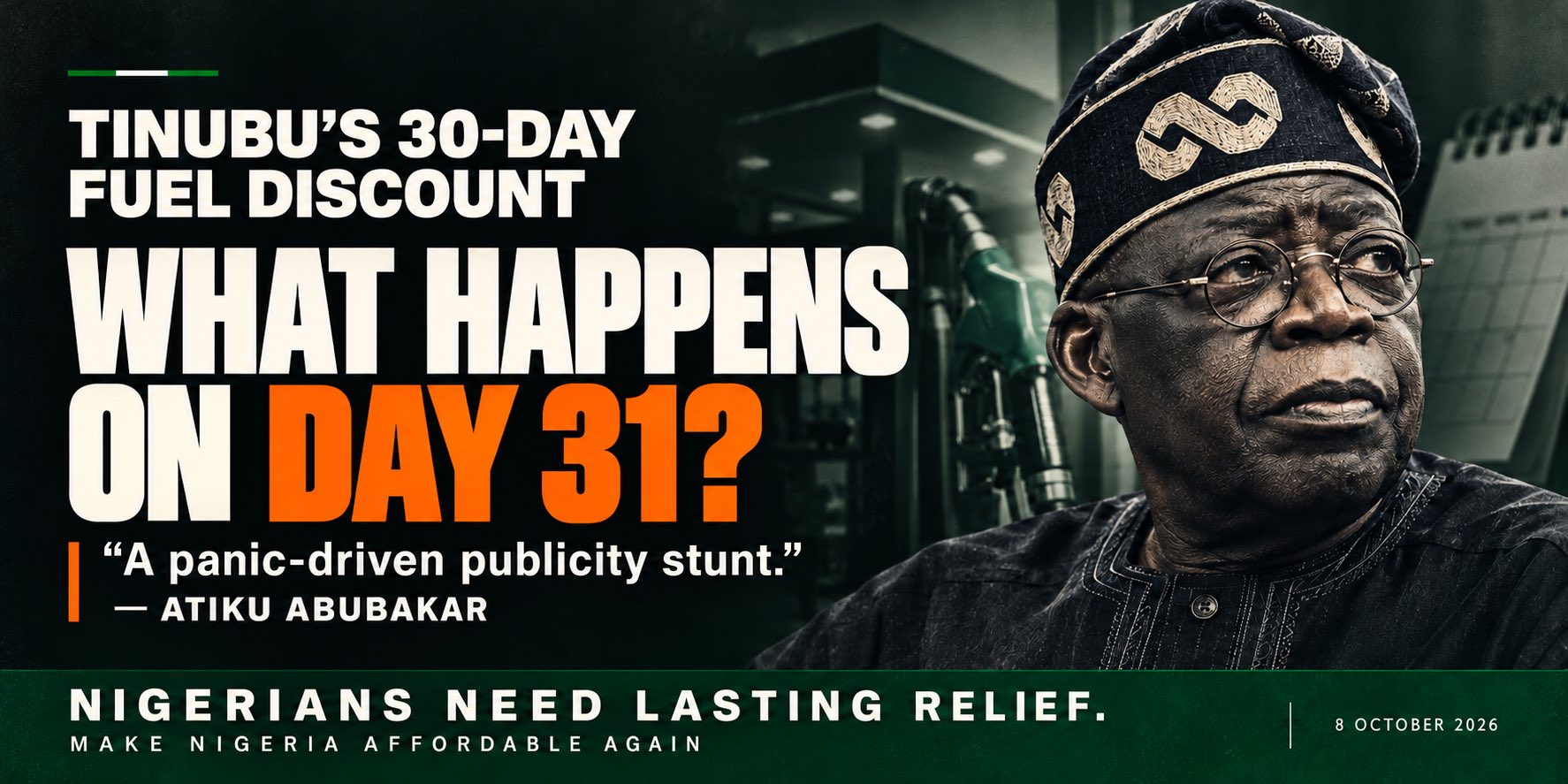
Former Vice President Atiku Abubakar has criticised the Federal Government’s proposed 30-day petrol discount at Nigerian National Petroleum Company Limited (NNPCL) retail outlets, describing the initiative as a panic-driven publicity stunt that cannot address the economic hardship Nigerians have endured.
Atiku, through a statement issued on Thursday by Phrank Shaibu, Director of Strategic Communication of the African Democratic Congress (ADC) Presidential Campaign Council, accused President Bola Tinubu’s administration of offering temporary relief after years of rising fuel prices and worsening cost-of-living pressures.
The former vice president described the initiative as a desperate political gesture, arguing that the government had failed to provide adequate relief to households and businesses struggling with high transportation costs, rising food prices and declining purchasing power.
He also questioned the timing of the announcement, suggesting that the administration was seeking to improve its political standing as the 2027 general elections approach.
“Atiku totally rejects this calendar-scheduled, election-laced subsidy package. Nigerians are not fools to be offered a month of discounted fuel after years of punishing prices and then expected to forget the hardship when the discount expires,” the statement quoted him as saying.
Atiku maintained that the proposed discount was not a comprehensive economic policy but a temporary measure that would leave the underlying problems unresolved.
He asked what would happen when the 30-day period expires, arguing that Nigerians could return to paying high prices for petrol and transportation while continuing to contend with the rising cost of essential goods.
According to him, a short-term intervention cannot substitute for a sustainable policy capable of reducing the cost of living and improving household welfare.
“What happens on Day 31? Nigerians wake up to the same brutal prices, the same punishing transport fares and the same rising cost of food,” he said.
The ADC presidential campaign council also raised concerns about the implementation of the proposed discount, noting that the government had limited the initiative to designated NNPCL retail outlets.
Atiku questioned whether the government had provided sufficient details about the amount motorists would save per litre and how the discount would benefit ordinary commuters.
He argued that without a clear mechanism to ensure that transport operators pass any savings on to passengers, the intervention might not significantly reduce the cost of public transportation.
The former vice president further described the government’s decision to introduce the temporary discount as evidence, in his view, that its earlier position on fuel pricing and relief measures required reconsideration.
He said the development strengthened his argument that the government could adopt a more structured system of production support to ease fuel costs while encouraging domestic refining.
Atiku recalled his proposal for capped and budgeted production support tied to petrol refined in Nigeria. He said the approach should include safeguards to ensure that the benefits reach consumers while supporting local refining capacity.
According to him, the proposal would provide a more sustainable framework than a temporary discount restricted to selected retail outlets.
He accused the Tinubu administration and its supporters of previously portraying such interventions as impractical, only for the government to introduce what he described as a subsidy-style measure in response to growing public frustration over fuel prices.
“This volte-face proves that the production-support proposal I have advanced is workable, achievable and not complicated,” he said.
Atiku insisted that Nigerians needed lasting economic relief rather than a temporary reduction in petrol costs that would expire after one month.
He argued that any effective government response should address the broader factors driving high transportation fares, food prices and the cost of running businesses.
The former vice president also reiterated his commitment to making essential goods and services more affordable, presenting the issue as a key point of difference between his political position and the Tinubu administration’s economic policies.
“Nigerians need lasting relief, not a countdown to the return of hardship,” he said, according to the statement.
The Federal Government had announced a 30-day petrol discount through NNPCL retail outlets, with public transport operators given priority. Finance Minister Taiwo Oyedele explained that the arrangement was not a subsidy but an initiative under which petrol would be sold at cost.
The announcement has generated political debate, with critics questioning whether the temporary measure would deliver meaningful relief and the government maintaining that the arrangement should not be confused with a return to the previous fuel subsidy regime.
Atiku concluded by reaffirming his promise to pursue policies aimed at reducing the cost of living if given the opportunity to lead the country.
The statement, dated October 8, 2026, ended with his campaign message: “Tinubu made life expensive. I will make life affordable again.”
It was signed by Phrank Shaibu, Director of Strategic Communication of the ADC Presidential Campaign Council.
