

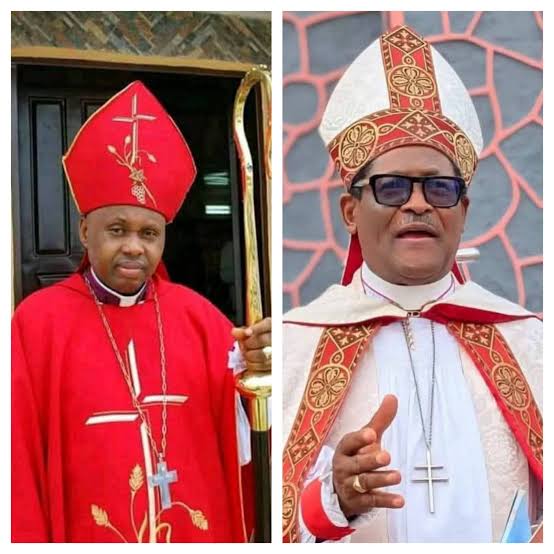
Ibezim instituted the suit against the Primate of the Church of Nigeria, Most Rev. Henry Ndukuba, and the Dean of the Church, Most Rev. Blessing Enyindah, seeking judicial interpretation of provisions of the church’s 2020 Constitution and Canons governing disciplinary proceedings against serving bishops.
The legal action comes days after Ndukuba directed Ibezim to proceed on six months’ compulsory leave with immediate effect, following investigations into allegations and recent developments within the Diocese of Awka.
In a letter dated October 13, 2026, the Primate also announced the appointment of the Bishop of the Diocese of Aguata, Rt. Rev. Samuel Ezeofor, as Supervising Bishop of the Diocese of Awka and Coordinating Bishop of the Province of the Niger during Ibezim’s absence.
However, in an originating summons filed on October 13 at the Awka Judicial Division of the Anambra State High Court, Ibezim challenged the constitution of the visitation team set up by the Primate and the procedures governing disciplinary action against a serving bishop.
The suit, marked A/371/2026, lists Ndukuba as the first defendant and Enyindah as the second defendant. Enyindah is also identified in the court documents as chairman of the visitation team constituted by the Primate.
In his application, the archbishop is asking the court to declare that the procedures stipulated in the Church of Nigeria’s Constitution and Canons must be followed before disciplinary measures are imposed on a serving bishop.
One of the reliefs sought states:
“A declaration that the laid down procedure for disciplining a serving Bishop of a Diocese of the Church of Nigeria (Anglican Communion) are spelt out in sections 55, 75(1)(2)(3)(4)(5), 76(1)(2)(3)(4)(5) and Canon XVI sections 22, 24, 25, 26, 27, and 28 of the Constitution and Canons of the Church of Nigeria (Anglican Communion), 2020.”
Ibezim is also seeking a declaration that the prescribed procedures must be strictly followed before any disciplinary measure or sanction, including suspension or removal from office, can be imposed on him as the incumbent Bishop of the Diocese of Awka and Archbishop of the Province of the Niger.
Another relief sought by the plaintiff concerns the specific offences for which senior clergy members can face disciplinary proceedings under the church’s regulations.
The application states:
“A declaration that at least one of the ten offences specifically listed or mentioned in section 1 of CANON XVI for which a Primate, a Provincial Archbishop, a Bishop, a Priest, or a Deacon in the Church of Nigeria (Anglican Communion) can be tried, must be proved before any form of disciplinary measure or sanction is imposed on the Plaintiff.”
The archbishop is further asking the court to interpret various provisions of the church’s Constitution and Canons concerning the powers, responsibilities and disciplinary procedures applicable to its officials.
A key issue raised in the suit is the legality of the visitation team constituted by the Primate.
The originating summons describes the team, established through a letter dated June 17, 2026, as having been “illegally constituted”.
The allegation forms part of Ibezim’s case and has not been established by a court. The legal proceedings will determine the issues raised in the application, subject to the court’s consideration of the relevant constitutional and canonical provisions.
The archbishop instituted the action through his lead counsel, B.E.I. Nwofor, SAN.
Ndukuba had explained that the decision to place Ibezim on six months’ compulsory leave was an administrative measure intended to facilitate an impartial investigation and restore peace within the Diocese of Awka.
The appointment of Ezeofor to oversee the diocese and coordinate the Province of the Niger during Ibezim’s absence was also announced as part of the administrative arrangements.
The court case is expected to bring the church’s constitutional and canonical procedures for investigating and disciplining serving bishops under judicial scrutiny.
The dispute raises questions about the interpretation and application of the Church of Nigeria’s internal rules, particularly the procedures that must be observed when allegations are investigated and disciplinary sanctions are considered against senior clergy members.
