

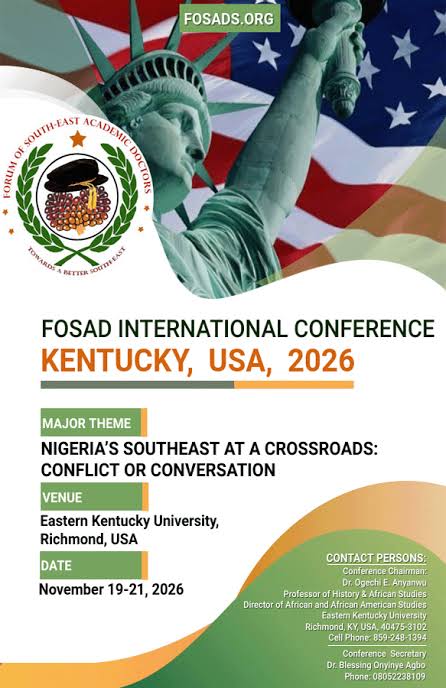
In his welcome address, the 2026 Conference Chair, Dr Ogechi E. Anyanwu, expressed delight that the conference could still hold despite the change in arrangements, noting that the virtual platform had provided an opportunity for participants to connect and share knowledge across geographical boundaries.
Dr Anyanwu acknowledged the contributions of the FOSAD leadership, the conference planning committee and other individuals whose efforts made the event possible.
He particularly commended the leadership of the Forum of South-East Academic Doctors for providing what he described as thoughtful, effective and visionary direction in advancing the organisation’s mission.
He also praised members of the planning committee for their dedication and commitment, noting that organising an international academic conference requires considerable time, coordination and effort.
The conference chair expressed appreciation to Professor Ogechi Adeola, who served as the keynote speaker, describing her participation as an honour and privilege to the organisers.
A major highlight of the conference, according to Dr Anyanwu, was the receipt of 72 abstracts for consideration, reflecting considerable interest among researchers and scholars.
He said the papers scheduled for presentation demonstrated a shared intellectual commitment to reclaiming the Igbo past and reimagining its future.
Dr Anyanwu expressed confidence that the presentations and discussions would deepen participants’ understanding of Igbo history, encourage greater appreciation of contemporary realities and expand perspectives on the possibilities for the future.
He urged participants to approach the academic discussions with open minds, stressing the importance of constructive engagement, critical examination of established beliefs and willingness to reconsider long-held assumptions.
According to hIm, the future of relationships and collaboration between the Igbo people and their neighbours, both within Nigeria and beyond, depends partly on the willingness of individuals and communities to engage in meaningful conversations and reassess their perspectives.
He emphasised that dialogue, rather than conflict, should remain the preferred approach to resolving differences and building sustainable relationships.
“Our choice is between conflict and conversation. I believe we must choose conversation,” she said.
The conference chair encouraged participants to listen to differing viewpoints and allow evidence, facts and reason to shape their understanding of society and the world.
He maintained that intellectual development and meaningful progress could only be achieved when individuals remained open to questioning their assumptions, learning from others and engaging in honest conversations.
Dr Anyanwu also highlighted the importance of FOSAD as a platform for bringing together academics, professionals and individuals with shared interests and aspirations.
He called on members to take collective responsibility for the growth and sustainability of the organisation by promoting its activities, encouraging wider participation and supporting its programmes.
Describing FOSAD as an association that belongs to all its members, she urged them to take ownership of its future and contribute actively to building the organisation they envision.
“We have come a long way, but there is still much further to go. And if we hope to go further, we must do so together,” she stated.
He added that every member had something valuable to contribute to the organisation’s development and called for stronger collaboration among members.
The conference chair concluded by thanking participants for their involvement and expressing hope that the gathering would produce engaging discussions, productive intellectual exchanges and meaningful outcomes.
The 2026 FOSAD International Conference provides another opportunity for the organisation to promote scholarly engagement, strengthen academic collaboration and encourage research-driven conversations on issues affecting the Southeast and the wider society.
Dr Ogechi Anyanwu is the Chair and Director of Center for Interdisciplinary Studies and Engagement, Eastern Kentucky University. He is a Professor of History & African Studies
