

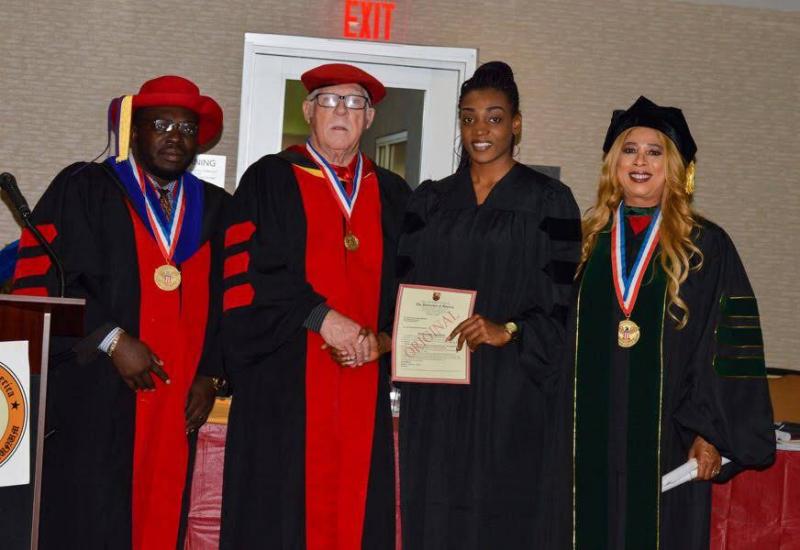
The commission said the institution had been admitting students, conducting academic programmes and advertising degree-awarding courses through centres that had not received its approval to operate as universities in Nigeria.
In a public notice issued on Tuesday and signed by its Director of Public Affairs, Rita N. Okonjo, the NUC identified the affected centres as Cosmopolitan International Business School, Garki, Abuja; its purported Federal Capital Territory Learning Centre; and the University of America College of Science and Technology, also known as UAPOLY, located in Ekpoma, Edo State.
The commission stressed that neither the foreign university nor the centres had been authorised to establish campuses, operate university programmes or award recognised degrees in Nigeria.
It urged members of the public to exercise caution and avoid making financial commitments to the institution or any of its affiliated centres.
NUC questions institution’s accreditation claims
The commission disclosed that investigations into the institution’s operations showed that the University of America, Curaçao, was not accredited by any agency recognised by the United States Department of Education or the Council for Higher Education Accreditation (CHEA).
It also challenged the institution’s claims concerning its registration and listing in certain American educational databases, explaining that such records did not automatically confer accreditation or legal authority to award recognised university degrees.
The NUC stated: “Investigations have established that the University is not accredited by any agency recognised by the United States Department of Education or the Council for Higher Education Accreditation (CHEA).
“Its purported listing in the Integrated Postsecondary Education Data System (IPEDS), as well as its claimed registrations in California and Florida, does not confer accreditation or authority to award recognised university degrees.”
The commission further dismissed claims that the institution had obtained approval from Nigerian regulatory agencies, including the Federal Ministry of Education, the Joint Admissions and Matriculation Board (JAMB), the National Board for Technical Education (NBTE) and the Nursing and Midwifery Council of Nigeria.
According to the NUC, such claims do not constitute authorisation to operate a university or award degrees in Nigeria.
It emphasised that the regulation of university education and the approval of degree-awarding institutions must comply with the relevant Nigerian laws and regulatory requirements.
NUC raises concerns over advertised courses
The commission expressed particular concern over the range of academic programmes allegedly being advertised by the institution and its affiliated centres.
The programmes reportedly include Law, Nursing Science, Engineering, Pharmaceutical Science, Aerospace and Rocket Engineering, as well as postgraduate qualifications, including Doctor of Philosophy (PhD) degrees.
The NUC also raised concerns about promotional claims allegedly promising students opportunities for mobilisation under the National Youth Service Corps (NYSC), professional recognition and access to Green Cards that would enable them to live and work in the United States or Europe.
It warned that such representations could mislead prospective students and parents into believing that qualifications obtained from the institution would enjoy official recognition in Nigeria and internationally.
The commission clarified that degrees obtained from unapproved institutions would not qualify holders for NYSC mobilisation, registration with relevant Nigerian professional regulatory bodies or admission into the Nigerian Law School.
It also cautioned that the use of facilities belonging to reputable public institutions for graduation ceremonies or other academic events should not be interpreted as official recognition or endorsement.
“The use of reputable public institutions as venues for ceremonies does not constitute endorsement or confer legitimacy on an unapproved university,” the commission stated.
Public urged to avoid affiliated centres
Following its findings, the NUC advised prospective students, parents, guardians and members of the public to avoid the University of America, Curaçao, and the identified Nigerian centres.
The commission specifically warned against seeking admission, paying tuition or other fees, or participating in academic programmes organised by the institution.
It also cautioned individuals and organisations involved in facilitating the operations that they could face appropriate regulatory and legal consequences.
The commission advised Nigerians to verify the accreditation and approval status of universities before making admission decisions or financial commitments.
It urged prospective students to consult its official website for the updated list of approved universities in Nigeria to avoid falling victim to fraudulent or unrecognised academic institutions.
The warning comes amid continuing efforts by the commission to address the proliferation of illegal universities, unauthorised study centres and institutions offering qualifications that may not be recognised by Nigerian regulatory authorities.
Distinguishing the Curaçao institution from Nigerian universities
The controversy has also drawn attention to the need to distinguish between the foreign institution identified by the NUC and other universities with similar names.
According to findings cited in the report, the University of America, Curaçao, is based in Willemstad, the capital of Curaçao, a constituent country within the Kingdom of the Netherlands.
Information on the institution’s official website describes its learning model as a combination of online distance education and on-campus sessions for programmes requiring practical or laboratory work.
However, the existence of a foreign institution does not automatically authorise the establishment of affiliated campuses or learning centres in Nigeria.
The report also identified a website, uoa.edu.ng, which describes itself as the University of America Curaçao Gad Campus in Anambra State. A review of the website reportedly revealed limited substantive information about the campus’s history, academic activities, accreditation and recognition.
Although the website contains headings relating to its history, colleges and faculties, it reportedly provides little detailed information about the institution’s academic operations. It also contains an apparent spelling error in the name of Anambra State.
These observations further underscore the importance of independently verifying the legal and accreditation status of institutions operating under foreign university names.
The University of America, Curaçao, should also not be confused with the American University of Nigeria (AUN), located in Yola, Adamawa State.
AUN was established by former Vice-President Atiku Abubakar and commenced student admissions in 2005. It received accreditation from the National Universities Commission in 2008.
The NUC’s warning therefore concerns the specific foreign institution and its identified Nigerian centres, not the American University of Nigeria.
As the commission intensifies its regulatory oversight of tertiary education, prospective students have been urged to prioritise institutional accreditation and official recognition over promotional claims, foreign affiliations or promises of internationally recognised qualifications.
The commission maintained that Nigerians must verify the status of any institution before enrolling, paying fees or investing years in academic programmes that may ultimately fail to secure recognition.
