

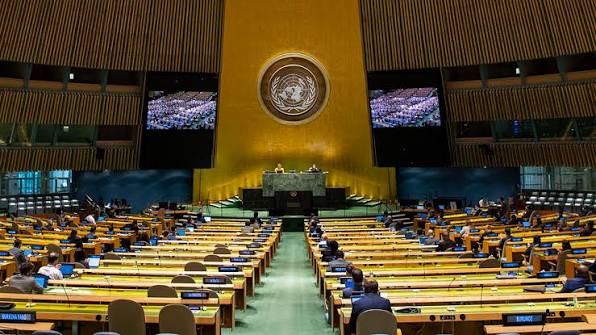
The Federal Government has cautioned opposition politicians against making claims it says could damage Nigeria’s international reputation amid continuing criticism over President Bola Ahmed Tinubu’s absence from the 81st United Nations General Assembly in New York.
The Minister of Information and National Orientation, Mohammed Idris, issued the warning while responding to public debate over Tinubu’s decision to mandate Vice-President Kashim Shettima to lead Nigeria’s delegation to the high-level UN gathering.
Idris said Tinubu is currently on annual leave and maintained that the President’s decision to delegate Shettima should neither be regarded as unusual nor interpreted as diminishing Nigeria’s diplomatic standing. (Channels Television)
According to the minister, Shettima has been given the President’s full mandate to represent Nigeria at the General Assembly and will undertake a series of diplomatic engagements on behalf of the country.
“President Tinubu is currently on annual leave, and his decision to ask the Vice President to lead Nigeria’s delegation is neither unusual nor a diminution of the country’s diplomatic standing,” Idris said.
The Vice-President is expected to deliver Nigeria’s national statement during the General Debate and participate in high-level meetings and bilateral discussions with world leaders, international organisations and development partners.
Idris said Shettima’s engagements would focus on issues central to Nigeria’s interests, including peace and security, economic development, climate action, reform of the global financial architecture, sustainable development and international cooperation.
“Vice President Shettima carries the full mandate of the President and the Federal Republic of Nigeria,” the minister said, stressing that Nigeria would therefore be “fully and effectively represented” throughout the high-level session.
The government’s position followed criticism from former Vice-President Atiku Abubakar over Tinubu’s absence from the UNGA for the third consecutive year.
Atiku questioned the decision and called for clarification on whether there was any legal, diplomatic, medical or personal reason preventing Tinubu from travelling to the United States. He also questioned the implications of the repeated delegation of the President’s UNGA responsibilities to the Vice-President.
The Federal Government rejected the suggestions raised by Atiku and what it described as commentary from a United States-based lobbying organisation retained by him.
Idris said the government had noted the criticism and accused the commentators of attempting to attribute what he called “false and baseless motives” to Tinubu’s decision not to attend the assembly personally.
The minister acknowledged that political opposition and robust public debate were legitimate elements of democracy but argued that speculation should not be presented to Nigerians or the international community as established fact.
“Political opposition and robust public debate are legitimate features of democracy. However, speculation should not be presented to Nigerians or the international community as established fact,” Idris said.
He urged political actors to exercise responsibility when discussing issues that could affect Nigeria’s international relationships and national reputation.
The minister also highlighted the longstanding relationship between Nigeria and the United States, noting that the bilateral relationship covers trade and investment, security cooperation, energy, democratic institutions, regional stability and extensive people-to-people ties.
According to Idris, Nigeria’s relationship with the United States is conducted through established diplomatic and governmental channels and should be distinguished from partisan political commentary or activities undertaken by private lobbying organisations.
The minister further appealed to Nigerians and the media to distinguish between verified information, political opinion and unsubstantiated claims when discussing Tinubu’s absence and Nigeria’s foreign relations.
The controversy comes as Shettima leads Nigeria’s delegation at the 81st UN General Assembly, where he is expected to present the country’s position on major international issues and engage foreign leaders and development partners.
The Federal Government has maintained that Shettima’s mandate is comprehensive and that Nigeria’s diplomatic interests will continue to be pursued throughout the General Assembly.
The 81st UNGA high-level week is taking place in New York from September 22 to 28, with Nigeria participating through the Vice-President and a delegation of senior government officials.
The dispute over Tinubu’s absence is therefore continuing alongside the broader diplomatic activities of the Nigerian delegation, with the government insisting that the President’s decision to remain on annual leave does not prevent Nigeria from participating fully in the United Nations proceedings.
