

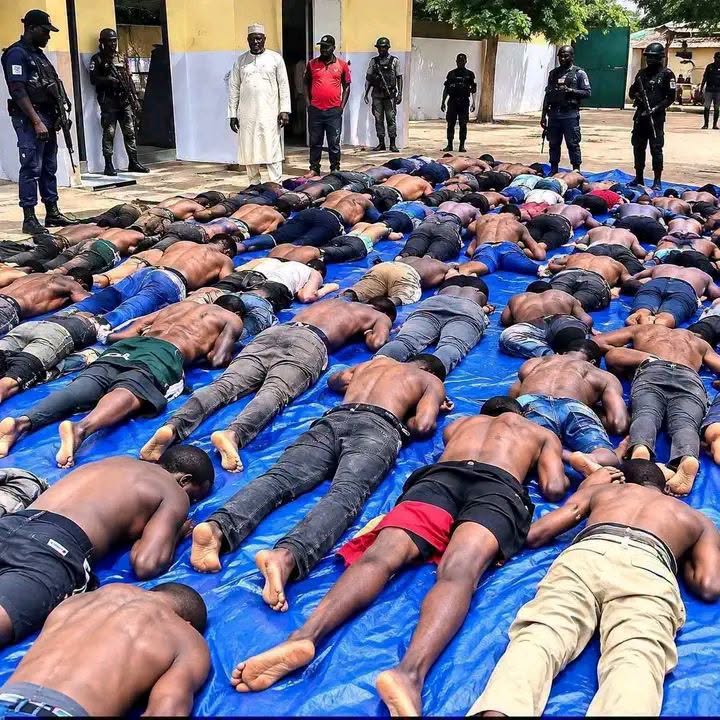
The Federal Government has suspended 21 officers of the Nigeria Security and Civil Defence Corps (NSCDC), including the Niger State Commandant, Suberu Aniviye, over the deaths of 37 suspected illegal miners while in the Corps’ custody.
The suspension was announced by the Minister of Interior, Olubunmi Tunji-Ojo, on Saturday, September 19, 2026, as the government intensified investigations into the circumstances surrounding the deaths.
The affected officers will remain suspended pending the conclusion of an independent investigation into the incident, which occurred after dozens of suspected illegal miners were arrested during enforcement operations in Niger State.
The Minister of Interior had earlier suspended the Niger State Commandant following the deaths, but the latest directive extends the suspension to 20 additional officers who were involved in the arrest, investigation, detention, security and supervision of the detainees. (Punch Newspapers)
The Federal Government has also constituted a 10-member independent committee to investigate the incident following President Bola Tinubu’s directive for a comprehensive probe.
According to the Ministry of Interior, the committee is expected to establish the identities of the deceased and examine the circumstances surrounding their arrest and detention, as well as determine the cause and circumstances of their deaths.
The panel is also mandated to establish whether there was responsibility, complicity, negligence or misconduct on the part of any individual or institution involved in the incident.
It is expected to recommend appropriate action against those found culpable and advise the government on compensation for victims’ families where applicable. The committee has two weeks to complete its assignment and submit its report.
The committee is chaired by retired Deputy Director-General of the Department of State Services, Jonathan Kure, while Professor Isa Hayatu Chiroma, SAN, former Director-General of the Nigerian Law School, serves as secretary.
Other members include retired Assistant Inspector-General of Police Hosea Hassan Karma; Professor Olayinka Buhari, a professor of Histopathology and former Chief Medical Director of the University of Ilorin Teaching Hospital; representatives of the Minna Emirate Council and Niger State Government; National Secretary of the Miners Association of Nigeria, Liman Sulaiman; human rights lawyer Deji Adeyanju; journalist Zainab Suleiman Okino; and public affairs analyst George Agbakahi.
The committee may also invite additional experts, inspect relevant facilities and locations, access official documents and records, and receive memoranda from members of the public.
The government has warned that anyone found attempting to destroy or conceal evidence, intimidate witnesses or obstruct the investigation could face consequences.
The 37 deceased persons were among scores of suspected illegal miners arrested by the Niger State Command of the NSCDC during enforcement operations in the M.I. Wushishi and Lukoto areas of the state on September 15 and 16.
The NSCDC said the operation formed part of efforts to tackle illegal mining activities in the state and that various exhibits were recovered during the arrests.
The detainees were subsequently taken into NSCDC custody in Minna.
The following day, the bodies of several detainees were reportedly discovered inside the facility, triggering widespread concern and anger.
The NSCDC initially attributed the deaths to a suspected disease outbreak. However, the Corps later acknowledged that the actual cause had not been established and that medical and laboratory examinations would be required to determine what happened.
Niger State Governor, Mohammed Umaru Bago, subsequently disclosed that 67 artisanal and suspected illegal miners had reportedly been detained in three cells, with 37 of them dying in the cell where the male detainees were held. He said authorities were considering several possibilities, including suffocation caused by overcrowding and possible exposure to hazardous substances.
Accounts from survivors have raised further questions about the conditions under which the detainees were held.
One survivor, Dauda Shehu, said the detainees were packed into an overcrowded and poorly ventilated cell and struggled to breathe.
“We were jam-packed in the cell, no ventilation for us to breathe well,” Shehu was quoted as saying.
Another survivor told Governor Bago and Minister Tunji-Ojo that a substance resembling perfume was allegedly sprayed inside an overcrowded cell shortly before some detainees began collapsing.
According to the survivor, about 17 people were initially inside the room before more detainees were brought in. He said the detainees complained that the room was too small and hot, but the number of people inside continued to increase.
He alleged that the door was eventually locked and a substance with a strong smell was sprayed into the room, after which some detainees began falling down. The allegation has not been established as the cause of the deaths.
Other survivors have alleged that detainees struggled for air and that some resorted to drinking their urine because of the extreme conditions inside the cell. These accounts are part of the evidence that authorities are expected to examine during the investigation.
The deaths have prompted investigations by several government institutions.
Inspector-General of Police, Olatunji Disu, visited Niger State and said the police would collaborate with the NSCDC and the state government to establish what led to the deaths.
Disu described deaths in custody as a serious matter and said the police would leave no stone unturned in determining the circumstances surrounding the incident.
The Federal Ministry of Solid Minerals Development has also deployed a team to Niger State to investigate the incident, while the state government has initiated its own inquiry.
President Tinubu has directed that the investigation be comprehensive and that officials found to have contributed to the deaths through negligence or other misconduct should face appropriate consequences.
Meanwhile, the deaths sparked protests and unrest in Minna, prompting the Niger State Government to impose a curfew as authorities attempted to restore calm.
For now, the precise cause of the 37 deaths remains unresolved. The independent panel, alongside medical, forensic and other investigations, is expected to establish what happened to the detainees, determine whether any official wrongdoing occurred and recommend measures to prevent a recurrence.
The suspension of the 21 NSCDC officers is therefore not a determination of guilt, but an administrative measure pending the outcome of the investigations.
