

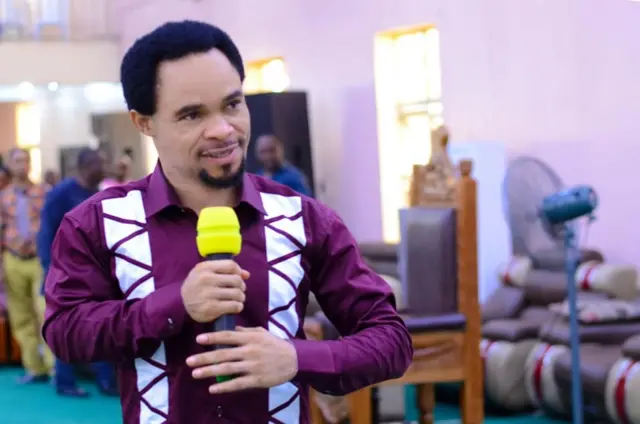
Prophet Chukwuemeka Ohanaemere, popularly known as Odumeje, has called for equitable distribution of major national infrastructure and facilities across Nigeria, arguing that equal access is essential to achieving genuine national unity.
The controversial cleric specifically demanded that the Southeast should have a functional seaport, an international airport and facilities for obtaining visas and accessing consular services, similar to what he described as available to other major ethnic groups in the country.
Speaking on the issue, Odumeje said the presence of such facilities in other parts of Nigeria should be matched by similar provisions in the Southeast.
“If Hausa people have a seaport, we have a seaport. Yoruba have seaport, we have seaport. That is what they call one Nigeria,” he said.
He also made a case for the establishment and development of international aviation facilities in the Southeast, stressing that people in the region should not be required to travel long distances to access international air services.
“If Hausa people have international airport, Yoruba have international airport. Igbo people will have their own international airport. That is what they call one Nigeria,” the cleric stated.
Odumeje extended his argument to diplomatic and consular services, particularly facilities where Nigerians can process visas and access services provided by foreign missions.
“If Hausa people have embassies, Yoruba people have embassies where they go and get visas. Igbo people will have their own embassies where they go and get visa,” he said.
The cleric described the alleged imbalance in the distribution and accessibility of national facilities as unfair, arguing that it raises questions about the practical meaning of national unity.
He expressed disappointment with political and community leaders in Igboland for what he described as their silence on issues affecting the region, particularly the demand for infrastructure and institutions that could strengthen its economic and international connectivity.
“It’s an insult to all the elites of Igboland. And it showing that, is an insult to the entire Igbo generation. No public talking about it,” he said.
Odumeje argued that the concept of one Nigeria should involve fairness, inclusion and equitable access to national opportunities and infrastructure, rather than merely political rhetoric.
“That is not one Nigeria. That is what they call deceive and lie,” he declared.
He further urged Igbo leaders and other stakeholders to look beyond immediate political considerations and consider the long-term implications of infrastructure deficits and unequal access to national facilities for younger generations.
“We are no more a boy. We are fathers,” Odumeje added.
His comments come amid longstanding debates over infrastructure development and economic integration in the Southeast, where stakeholders have repeatedly called for improved transportation networks, greater industrial investment, expanded international connectivity and stronger federal presence.
The cleric’s remarks therefore place the question of equitable infrastructure distribution within a broader discussion about federalism, national integration and the need to ensure that citizens across Nigeria’s geopolitical zones have comparable opportunities to participate in economic and international activities.
For Odumeje, providing the Southeast with facilities comparable to those available elsewhere would represent not merely an infrastructure decision, but a practical demonstration of the principle of one Nigeria.
